
How Redox Flow Batteries Work
Understanding the architecture helps explain both the promise of RFBs and the engineering challenges that remain.
From Tanks to Stack—and Back Again
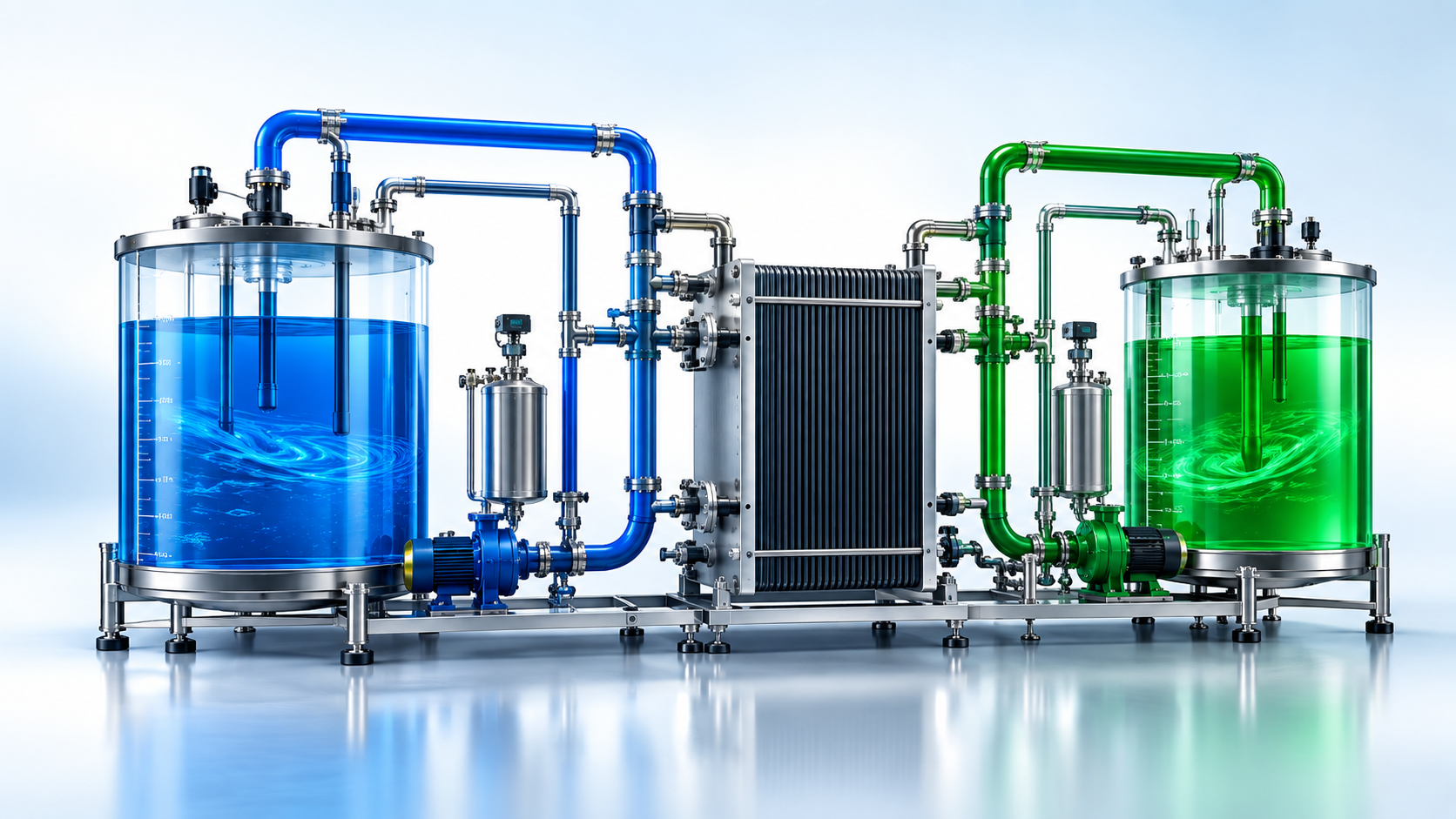
Two liquid electrolytes are stored in external reservoirs and pumped through opposing half-cells in an electrochemical stack. At the electrodes, redox reactions convert chemical energy to electrical energy during discharge and reverse during charging. A membrane or separator supports ionic conduction while limiting unwanted crossover.
Because active material is predominantly stored in tanks rather than inside the stack, the system can be engineered by changing electrolyte inventory, tank volume, stack area and number of cells.
The Six Interconnected Engineering Problems
1. Electrolyte
Concentration, solubility, viscosity, conductivity, redox potential and chemical stability influence energy density and pumping losses.
2. Electrodes
Reaction kinetics, surface chemistry, wettability and mass transfer influence polarization and achievable power.
3. Membrane
Ionic conductivity must be balanced against crossover and chemical stability.
4. Cell & Stack
Flow fields, compression, electrical resistance, shunt currents and pressure drop become critical at scale.
5. Balance of Plant
Pumps, piping, sensors, thermal management and controls contribute to efficiency, cost and reliability.
6. Lifetime
Electrolyte decomposition, crossover, precipitation and component aging influence capacity retention and lifetime economics.
Research Frontiers
Higher Energy Density
Recent literature emphasizes wider usable cell voltage, multi-electron chemistry and higher active-material concentration as major pathways.
Higher Power Density
Low-resistance membranes, faster reaction kinetics, optimized porous electrodes and improved mass transfer can reduce polarization.
Lower Cost & Longer Life
Abundant active materials, stable molecules, selective membranes and efficient system design remain central commercialization targets.
Technical content is based on peer-reviewed reviews summarized on the Research page.